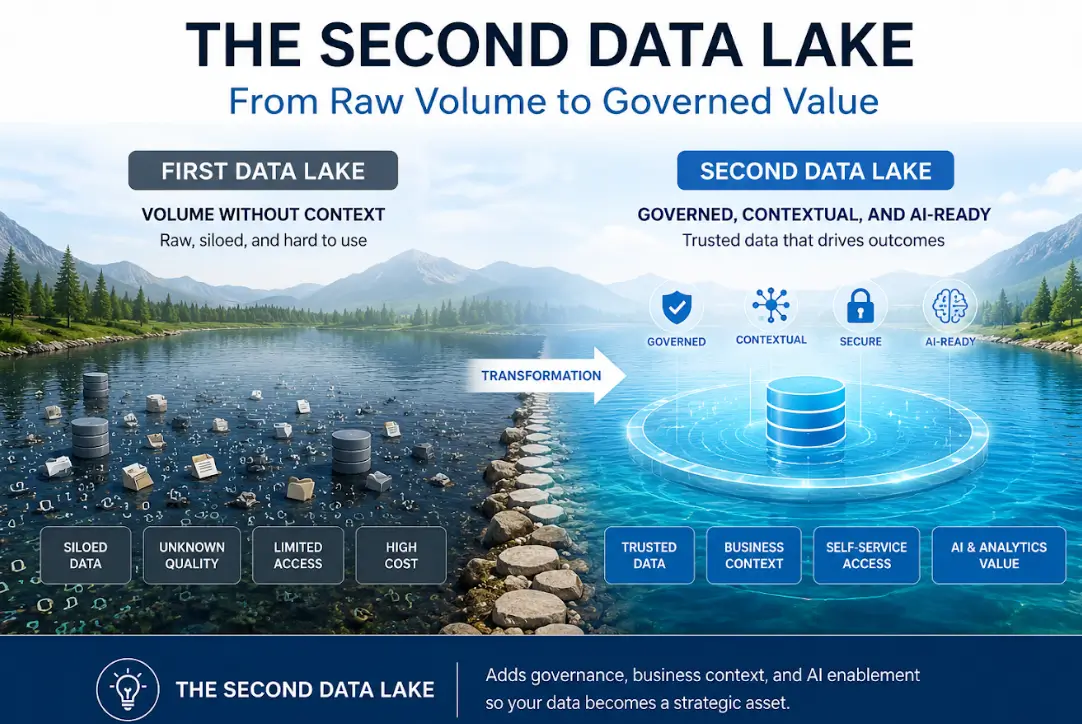
Enterprise organizations are investing in AI context layers, semantic models, metadata catalogs, and business glossaries to help AI systems understand enterprise data.
These technologies can make enterprise AI more useful and reliable.
But they introduce a new challenge:
How can organizations provide AI with the context it needs without creating another large, manually maintained data-management layer?
This is the problem behind the Second Data Lake concept.
The goal is not to avoid semantic or contextual information. The goal is to make that context dynamic, connected, governed, and maintainable as the enterprise changes.
What Is the Second Data Lake Problem?
The Second Data Lake problem occurs when an organization creates a large layer of semantic definitions, metadata, relationships, and business context for AI but cannot keep that information synchronized with constantly changing enterprise data.
Enterprise data changes continuously.
Schemas evolve. Applications change. New data sources appear. Business definitions are updated.
If the context layer depends primarily on manual updates, it can become stale.
The result can be:
Changing enterprise data → outdated context → incorrect AI interpretation → unreliable AI output
For AI agents, the risk can be even greater because an incorrect interpretation may influence an automated action.
Why Do Enterprises Need an AI Context Layer?
AI models are powerful at understanding language and patterns.
However, enterprise data contains organization-specific meaning.
For example, the term “customer” may have a precise definition inside an organization.
It could mean:
Any registered account An account with an active contract A customer with a recent transaction A paying customer A strategic enterprise account
A general-purpose AI model cannot safely assume which definition the organization uses.
An AI context layer can provide the business meaning required to interpret enterprise data correctly.
Why Can an AI Context Layer Become a Problem?
The context layer itself is not the problem.
The problem occurs when the context layer becomes a separate, static, manually maintained repository that does not evolve with the enterprise.
Organizations may create:
Business glossaries Semantic models Data dictionaries YAML definitions Metadata catalogs Wikis Ontologies Relationship maps Business rules
Each resource can be useful.
But every additional resource can also create another maintenance dependency.
When the enterprise changes, all affected contextual information needs to remain accurate.
What Causes AI Context to Become Outdated?
Several factors can contribute to stale context.
Schema Changes
Database tables and fields may be added, removed, renamed, or modified.
New Applications
Organizations continually introduce new enterprise applications and data sources.
Business Process Changes
Business workflows and operational processes evolve.
Metric Changes
Organizations may change how KPIs and business metrics are calculated.
Terminology Changes
Business teams may change the meaning or use of important terms.
Data Migration
Information may move from one platform or application to another.
Organizational Changes
Ownership and responsibility for data can change when teams or business structures change.
What Is the Best Way to Prevent the Second Data Lake?
The best approach is to reduce dependence on manually maintained context and connect context management more closely to the actual enterprise data environment.
This can involve:
Automated context discovery Continuous change detection Context synchronization Relationship discovery Business validation Governance Context quality monitoring Explicit ambiguity handling
The objective is to make context an evolving part of the enterprise data environment rather than a static documentation project.
- Automate Context Discovery
Automated context discovery can reduce the amount of information that people need to manually document.
Enterprise systems already contain valuable signals about:
Tables Fields Data types Relationships Sources Ownership Lineage Usage patterns
Where these relationships can be discovered automatically, organizations should avoid requiring people to recreate them manually.
Why does this matter?
Suppose an enterprise has thousands of tables.
Manually documenting every relationship could require significant effort.
Automated discovery can identify candidate relationships and provide them as contextual information for AI systems.
Human experts can then focus on validating business meaning.
- Detect Schema Changes Automatically
Schema-change detection helps identify when the underlying enterprise environment changes in ways that could affect AI context.
For example:
Before
customer_status
After
account_status
This change may affect:
Semantic definitions Business rules AI queries Metrics Relationships Documentation
An effective context architecture should be able to identify that something changed and determine whether associated context requires attention.
- Keep Context Synchronized
Detecting a change is only the first step.
The relevant contextual information must also be updated or reviewed.
Organizations should establish a process for keeping:
Metadata Definitions Relationships Lineage Business rules AI instructions
aligned with the current enterprise environment.
The important question is not:
“Does the system update periodically?”
Instead, ask:
“How quickly does the context layer reflect an important change in our production environment?”
That measurable response time is a useful indicator of context freshness.
- Combine Automation With Human Expertise
Automation should not attempt to replace business expertise.
Some information can be discovered technically.
Other information requires organizational knowledge.
For example:
A system may discover that:
customer_id is connected to order_id.
But only a business expert may be able to confirm:
“A customer is considered active only when the account has an active contract.”
The strongest approach combines:
Machine-discovered context + human-defined business meaning
This reduces manual effort while preserving business accuracy.
- Establish a Single Source of Context
Another common problem is fragmentation.
One definition may exist in:
A data catalog A wiki A BI dashboard A spreadsheet A YAML file A business document
Different teams may then use different definitions.
Organizations should establish authoritative contextual information for important business concepts.
For example:
Approved definition: Active Customer
Then AI systems, analytics systems, and business users can reference the same definition.
- Connect Business Context With Technical Metadata
Technical metadata tells AI what exists.
Business context tells AI what it means.
Both are important.
For example:
Technical metadata
revenue_amount Data type: Decimal Source: ERP system
Business context
Revenue amount represents recognized revenue according to the organization's approved accounting definition.
The combination is much more useful to AI.
- Monitor Context Freshness
Context should not be considered permanently correct.
Organizations should monitor whether important definitions and relationships remain aligned with the current enterprise environment.
Useful questions include:
When was this definition last validated? What source does it come from? Has the underlying schema changed? Who owns the definition? Has the business meaning changed? Are multiple definitions conflicting?
This creates a more proactive approach to context management.
- Build Governance Into the Context Layer
AI context requires governance just as enterprise data does.
Governance should address:
Ownership Access Security Compliance Data lineage Definition approval Change management Auditability
For AI agents, governance should also consider:
What the agent can access What the agent can infer What the agent can change What actions require approval When a human should intervene 9. Make Ambiguity Handling a Requirement
A reliable AI system should not always attempt to answer immediately.
Sometimes the correct response is:
“I need clarification.”
For example:
“Show me our highest-value customers.”
Highest-value according to what?
Revenue? Profit? Contract value? Customer lifetime value?
If the context does not establish the definition, an AI system should ask for clarification.
This is especially important for AI agents because guessing can potentially lead to an incorrect action.
- Test With Real Enterprise Data
A context solution may perform well in a controlled demonstration but behave differently in a complex enterprise environment.
Organizations should evaluate solutions using realistic data structures and workflows.
Test scenarios should include:
Schema changes New tables Renamed fields Conflicting definitions Missing metadata Ambiguous questions Multiple data sources Changing business rules
The goal is to determine whether the context system can adapt to real-world enterprise complexity.
What Should Enterprises Measure?
Organizations should establish measurable indicators for context quality.
Context Freshness
How quickly does context reflect important data changes?
Definition Accuracy
Do business definitions match approved organizational meaning?
Relationship Accuracy
Are relationships between entities correctly represented?
Coverage
How much important enterprise data has usable context?
Governance
Can organizations identify ownership, access, and lineage?
Ambiguity Handling
Can AI identify when it does not have enough information?
Change Responsiveness
How quickly can the system respond to changes in enterprise applications and schemas?
These measurements are more useful than simply asking whether an organization “has a semantic layer.”
Manual vs. Sustainable Context Management Manual Context Approach Sustainable Context Approach Definitions maintained manually Automated discovery + human validation Periodic updates Continuous change detection Documentation-centric Environment-aware Static relationships Discoverable relationships Multiple documentation sources Authoritative context Difficult to measure freshness Measurable freshness Reactive maintenance Proactive monitoring Higher maintenance burden Reduced manual effort
The objective is not necessarily to eliminate manual work.
It is to focus human effort where human judgment provides the most value.
How Does This Prevent the Second Data Lake?
The Second Data Lake emerges when context grows faster than an organization can maintain it.
A sustainable architecture changes the model.
Instead of:
Create context → document context → manually update context
the goal becomes:
Discover context → validate context → synchronize context → continuously monitor context
This changes context from a static documentation exercise into a continuously evolving part of the enterprise data environment.
What Should an AI Context Layer Be Able to Do?
Before adopting an AI context solution, organizations should look for capabilities such as:
Automated metadata discovery Schema-change detection Relationship discovery Business terminology management Data lineage Governance Context synchronization Stale-context detection Ambiguity handling Enterprise-scale support Auditability
The exact implementation will vary by platform, but these capabilities provide a useful evaluation framework.
Second Data Lake Prevention Checklist
Enterprises can use the following checklist when evaluating their AI context strategy:
Can the system automatically discover enterprise metadata?
Can it identify relationships between data entities?
Can it detect schema changes?
Can it identify context affected by those changes?
Can it keep important context synchronized?
Can business users define organization-specific terminology?
Can the organization establish authoritative definitions?
Can context ownership be identified?
Can stale context be detected?
Can AI ask for clarification when information is ambiguous?
Can context be governed and audited?
Can the solution be tested against real enterprise data?
How Does the Second Data Lake Relate to AI Governance?
AI governance traditionally focuses on areas such as:
Model behavior Security Privacy Compliance Access Monitoring
But reliable AI also depends on the information AI uses to understand the business.
Therefore, governance should extend to:
Data → Context → AI reasoning → AI action
If the context is incorrect, governance controls alone may not prevent an AI system from making a poor decision based on inaccurate information.
What Is the Future of AI Context Management?
As enterprises deploy more AI agents, context management will become increasingly important.
The future is unlikely to be based entirely on static documents or manually maintained semantic models.
Instead, organizations will need context that can:
Discover Adapt Synchronize Validate Govern Explain Respond to change
The fundamental principle is simple:
AI context should evolve at the speed of the enterprise data environment.
Key Takeaways An AI context layer can become a Second Data Lake when it becomes large, static, fragmented, and difficult to maintain. The solution is not to eliminate context but to make context more dynamic and connected to enterprise data. Automated discovery can reduce manual context-creation work. Schema-change detection can help identify when context needs to change. Human experts should continue to define business-specific meaning and rules. Organizations should establish authoritative definitions for important business concepts. Context freshness should be measurable. Governance should cover both enterprise data and the context used by AI. AI systems should ask for clarification rather than guess when ambiguity matters. Testing against real enterprise data is essential before deploying AI agents at scale. Frequently Asked Questions How can enterprises prevent an AI context layer from becoming a Second Data Lake?
Enterprises can reduce the risk by automating context discovery, monitoring schema changes, synchronizing context with enterprise data, establishing authoritative definitions, continuously validating context, and combining automation with human business expertise.
What causes the Second Data Lake problem?
The problem occurs when organizations create large collections of semantic definitions, metadata, relationships, and business context but cannot keep them synchronized with continuously changing enterprise data.
Should AI context be manually maintained?
Human input remains important for organization-specific business terminology and rules, but relying entirely on manual maintenance can become difficult at enterprise scale.
How can AI context be kept current?
AI context can be kept current through automated metadata discovery, schema-change detection, dependency analysis, synchronization, continuous validation, and context-freshness monitoring.
Why is schema-change detection important?
Schema changes can make existing metadata, relationships, and semantic definitions inaccurate. Detecting these changes helps organizations identify context that needs to be updated or reviewed.
Can AI automatically build a semantic layer?
AI and automation can assist with discovering metadata, relationships, and patterns. However, organization-specific business meaning and policies may still require human validation.
What is context freshness?
Context freshness describes how accurately and quickly the contextual information used by AI reflects the current enterprise data environment and business rules.
Why should AI ask clarifying questions?
If a request has multiple possible interpretations, guessing can lead to an incorrect result. Clarification allows AI to determine the intended business meaning before proceeding.
How does AI agent governance relate to context?
AI agent governance controls how agents access information, make decisions, and take actions. Reliable context is an important part of this governance because agents may rely on contextual information when making decisions.
What should enterprises test before adopting an AI context layer?
Organizations should test schema changes, new data sources, conflicting definitions, ambiguous questions, data relationships, context freshness, governance, and real enterprise workflows.
Is the Second Data Lake a physical data repository?
Not necessarily. The term describes a conceptual problem: the accumulation of semantic and contextual information that becomes difficult to maintain as enterprise data and business environments change.
What is the most important requirement for an AI context layer?
One of the most important requirements is keeping context aligned with the changing enterprise environment. Context that is rich but outdated can be less useful than context that is current, governed, and reliable.
Conclusion
The rise of AI creates a new enterprise data challenge.
Organizations need to provide AI systems with business meaning, relationships, metadata, and context. But simply creating another collection of semantic definitions and documentation can reproduce many of the maintenance problems enterprises experienced with traditional data lakes.
That is the Second Data Lake risk.
The solution is not to avoid context.
It is to build context that is dynamic, connected, governed, discoverable, and continuously aligned with enterprise data.
Automation can reduce the burden of technical discovery and maintenance. Human experts can provide business meaning and judgment. Governance can ensure that context is trustworthy and appropriately controlled.
Most importantly, enterprises should evaluate not only whether an AI system has context, but whether that context can keep up with the organization it is supposed to understand.
That is the key to preventing today's AI context layer from becoming tomorrow's Second Data Lake.
Related reading: The Second Data Lake — understand the emerging challenge of maintaining enterprise context for AI.
Comments
Join the discussionNo comments yet. Be the first to comment.