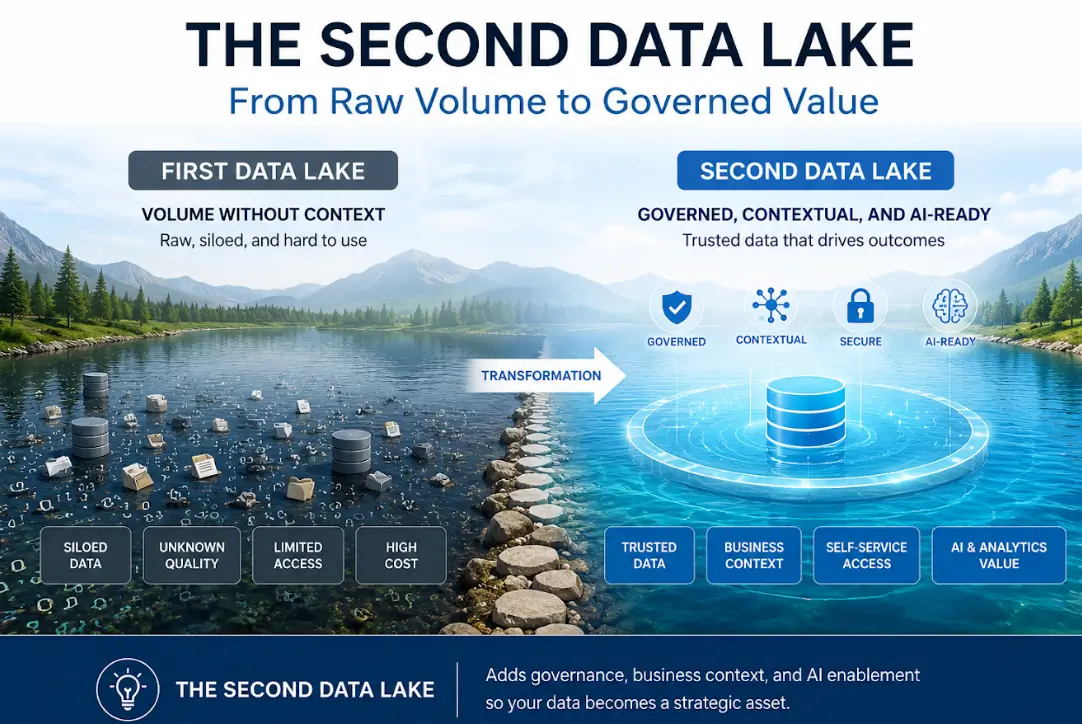
Why AI-Ready Enterprise Data Matters for Agentic AI
Agentic AI is changing the way enterprises think about artificial intelligence.
Traditional AI applications typically respond to a request, generate an answer, or perform a specific task.
Agentic AI can go further.
AI agents can potentially retrieve information, reason through multiple steps, interact with tools, access enterprise systems, and participate in business workflows.
But there is a fundamental requirement behind these capabilities:
AI agents need reliable enterprise data and context.
An intelligent agent operating on incomplete, outdated, poorly governed, or inaccessible information can produce unreliable results or take inappropriate actions.
That is why AI-ready enterprise data is becoming a critical foundation for agentic AI.
What Is AI-Ready Enterprise Data?
AI-ready enterprise data is information that has been prepared so that AI applications can appropriately discover, understand, access, and use it.
Being AI-ready involves more than simply storing data in a cloud platform or data lake.
Enterprise data may need to be:
Governed Validated Classified Secured Accessible Contextualized Discoverable Connected to relevant business relationships
For example, an enterprise may have customer information stored in databases while contracts, policies, emails, and historical documents exist in separate repositories.
An AI agent may need information from all of these sources to complete a business task.
The challenge is therefore not simply:
“Do we have data?”
The more important question is:
“Can an AI system safely understand and use the right enterprise data?”
Why Agentic AI Needs Better Data
A conversational AI system may be able to generate a response from the information provided in a prompt.
An enterprise AI agent can have a much broader responsibility.
An agent may need to:
Understand a business request. Identify the information required. Retrieve information from enterprise systems. Interpret that information. Decide what action is appropriate. Interact with another application. Complete a workflow. Report the result.
Every step can depend on enterprise data.
If the data is unreliable, the agent's reasoning can be affected.
If the data is inaccessible, the agent may not have enough information.
If the data lacks context, the agent may misunderstand its meaning.
If permissions are unclear, the agent may access information it should not use.
This makes data readiness a fundamental requirement for enterprise agentic AI.
The Difference Between AI-Ready and AI-Activated Data
There is an important distinction between data being AI-ready and data being actively used by AI.
AI-ready data has the foundation required for AI use.
It can be:
Governed Validated Preserved Classified Made accessible Enriched with context
AI-activated data goes a step further.
It can be used to:
Answer questions Power AI applications Support business workflows Provide context to AI agents Enable automated actions
This distinction matters because simply preparing data does not automatically create business value.
The value comes when trusted data can actually be used by AI systems.
- Data Governance Is the Foundation
Agentic AI introduces a greater need for data governance.
An AI agent may interact with multiple data sources and enterprise applications.
Organizations therefore need to understand:
Which data the agent can access Which users can authorize an agent What actions an agent can perform Which information is sensitive How agent activity should be monitored How access should be revoked How actions should be audited
Data governance provides the foundation for these controls.
Without governance, connecting an autonomous or semi-autonomous AI system to enterprise data can create unnecessary security and compliance risks.
- Context Makes Enterprise Data Useful
Data without context can be difficult for AI systems to interpret.
Consider a database containing thousands of fields.
An AI system may technically be able to access the database, but that does not necessarily mean it understands:
What each field means How tables relate to one another Which fields are authoritative Which business process created the data Which terminology the organization uses Which relationships exist between records
This is where semantic context becomes important.
A semantic layer can help connect technical data structures with business meaning.
For agentic AI, this can provide the context required to reason about enterprise information more effectively.
- Application Knowledge Matters
Enterprise applications contain business logic that may not be obvious from database schemas alone.
For example, an enterprise application may contain relationships between:
Customers Orders Products Invoices Contracts Employees Suppliers
Understanding these relationships can help AI systems interpret enterprise information.
SOLIXEmpower 2026 includes discussions around the Application Knowledge Graph, including a workshop focused on building an AKG with Data Sense. The event also includes a session on automating data access with the Application Knowledge Graph.
This reflects a broader idea:
AI needs business context, not just database access.
- Data Quality Directly Affects AI Reliability
AI agents can only work with the information available to them.
If enterprise data contains:
Duplicate records Missing information Outdated information Incorrect classifications Conflicting values Broken relationships
the agent may produce unreliable results.
Data quality therefore becomes especially important when AI systems move from answering questions to taking actions.
An incorrect answer may be inconvenient.
An incorrect automated action can be much more serious.
This is why organizations need to evaluate data quality before allowing AI agents to operate on enterprise information.
- Security Must Follow the Data
Agentic AI requires carefully designed access controls.
An AI agent should not automatically receive unrestricted access to enterprise information simply because it needs data to perform a task.
Organizations need to define appropriate permissions.
For example:
User permissions → Agent permissions → Data permissions → Action permissions
These controls can help ensure that an AI agent only accesses the information and systems required for its authorized purpose.
This is particularly important when agents interact with sensitive financial, healthcare, customer, employee, or operational information.
- AI Agents Need Reliable Enterprise Context
Consider an employee asking an AI agent:
“Show me the outstanding contracts for this customer and identify which ones require attention.”
To answer accurately, the agent may need to understand:
Which customer is being referenced Which contracts belong to that customer Which contracts are active Which contracts are expired What “require attention” means Which business rules apply Whether the user has permission to view the information
This is not simply a natural-language problem.
It is a data + context + governance problem.
The AI model provides intelligence, but the enterprise information environment provides the context required for the task.
- Agentic AI Increases the Importance of Governance
Agentic AI introduces a significant difference from traditional generative AI.
A generative AI system may produce a recommendation.
An AI agent may potentially act on that recommendation.
For example, an agent could potentially:
Create a ticket Update a record Retrieve information Send a notification Trigger a workflow Initiate a business process
This creates a new governance question:
What should an AI agent be allowed to do?
Organizations need to define boundaries around:
Actions Data access System access Human approval Monitoring Auditability
The greater the autonomy, the more important these controls become.
- From RAG to Enterprise Context
Retrieval-augmented generation, or RAG, has become a common approach for connecting AI systems with external information.
RAG can help an AI system retrieve relevant information before generating a response.
However, enterprise environments can contain highly complex information structures.
Organizations may have:
Structured databases Unstructured documents Historical archives Business applications Data warehouses Data lakes Knowledge repositories
Simply retrieving a document may not provide the full business context required for an enterprise workflow.
This is why semantic relationships, metadata, application knowledge, governance, and permissions can become important components of enterprise AI architecture.
- AI-Ready Data Requires an Enterprise Data Strategy
Preparing data for AI should not be treated as a one-time project.
Enterprise data changes continuously.
New applications are introduced.
Old systems are retired.
Documents are created.
Business processes change.
Data policies evolve.
AI use cases expand.
A sustainable AI-ready data strategy therefore needs to account for the complete data lifecycle.
Organizations should continuously evaluate:
Data quality Data classification Data governance Data access Data lineage Data retention Business context AI usage
This makes AI readiness an ongoing capability rather than a one-time migration exercise.
- What Enterprises Should Do Before Deploying AI Agents
Before connecting an AI agent to enterprise systems, organizations should evaluate several areas.
Step 1: Identify the Data
Determine which information the agent needs.
Step 2: Understand the Context
Identify relationships, business terminology, metadata, and application logic.
Step 3: Establish Governance
Define ownership, access policies, security controls, and accountability.
Step 4: Validate Data Quality
Identify incomplete, outdated, duplicate, or conflicting information.
Step 5: Define Agent Permissions
Specify what the agent can read, create, modify, or execute.
Step 6: Establish Human Oversight
Determine which actions require human approval.
Step 7: Monitor Agent Activity
Track what information the agent accesses and what actions it performs.
Step 8: Measure Outcomes
Evaluate whether the agent is actually improving business processes.
This approach can help organizations move toward more controlled and reliable agentic AI adoption.
SOLIXEmpower 2026 and the AI-Ready Data Conversation
SOLIXEmpower 2026 provides a useful example of how enterprise AI discussions are increasingly connected to data management.
The event's three primary areas are:
Enterprise AI Enterprise Data Governance Cloud Data Management
Its agenda also includes topics such as secure AI semantic layers, enterprise AI agents, agentic enterprise architectures, enterprise data and AI governance, and AI applications in finance, healthcare, and pharmaceuticals.
The event is scheduled for October 28–30, 2026, at UC San Diego in San Diego, California.
For technical professionals interested in how enterprise data can support AI and agentic workflows, SOLIXEmpower 2026 in San Diego provides an opportunity to explore these topics through keynotes, panels, workshops, and technical discussions.
The AI-Ready Data Architecture for Agentic AI
A practical enterprise architecture can be viewed as a series of connected layers:
Enterprise Sources
↓
Data Management
↓
Governance and Security
↓
Semantic and Business Context
↓
AI-Ready Data
↓
AI Applications
↓
AI Agents
↓
Business Workflows
↓
Business Outcomes
Each layer supports the next.
If the data layer is weak, the AI layer inherits those weaknesses.
If governance is missing, agentic systems can introduce additional risks.
If context is incomplete, AI systems may struggle to understand enterprise information.
If permissions are poorly defined, agents may have inappropriate access.
The architecture therefore needs to be considered as a complete system.
AI-Ready Data Is Becoming an Enterprise Requirement
The conversation around enterprise AI is changing.
Organizations are no longer asking only:
“Which AI model should we use?”
They are increasingly asking:
“What data foundation do we need to make AI useful?”
And with agentic AI, another question becomes important:
“What information and controls does an AI agent need before it can safely act?”
These questions shift the focus from AI models alone toward enterprise information architecture.
The organizations that can govern, contextualize, secure, and activate their data may be better positioned to build reliable AI applications and agentic workflows.
Frequently Asked Questions What is AI-ready enterprise data?
AI-ready enterprise data is information that has been appropriately governed, validated, secured, contextualized, and made accessible for AI applications.
Why does agentic AI need AI-ready data?
Agentic AI may retrieve information, reason across multiple sources, interact with tools, and perform business tasks. Reliable and governed data helps provide the information and context required for those activities.
Is AI-ready data the same as AI-activated data?
No. AI-ready data has the governance, quality, preservation, and contextual foundation required for AI. AI-activated data is actually being used by AI applications, natural-language interfaces, or agents to produce answers, applications, or actions.
Why is data governance important for AI agents?
AI agents may have access to enterprise systems and information. Data governance helps organizations define ownership, permissions, security, accountability, and appropriate data usage.
What is a semantic layer for AI?
A semantic layer connects technical data structures with business meaning. It can help AI systems understand relationships, terminology, and context within enterprise information.
What is an Application Knowledge Graph?
An Application Knowledge Graph represents relationships and business concepts within enterprise applications, helping connect data structures with application and business context.
How does data quality affect agentic AI?
Poor-quality data can lead to incorrect or incomplete information being used by an AI agent. When agents can take actions, inaccurate information can potentially lead to incorrect business outcomes.
Does agentic AI require human oversight?
The appropriate level of human oversight depends on the use case and the actions an agent can perform. Higher-impact or sensitive actions may require stronger approval and monitoring mechanisms.
What topics related to agentic AI are covered at SOLIXEmpower 2026?
The event agenda includes enterprise AI agents, agentic enterprise discussions, AI governance, secure AI semantic layers, and enterprise data and AI governance, along with industry-specific AI applications.
When is SOLIXEmpower 2026?
SOLIXEmpower 2026 is scheduled for October 28–30, 2026, at UC San Diego in San Diego, California.
Key Takeaways AI-ready data is a foundation for agentic AI. AI agents need more than access to raw enterprise data. Governance helps control how AI systems access and use information. Semantic context can help AI understand enterprise data and relationships. Data quality directly affects AI reliability. Agentic AI introduces additional requirements around permissions, monitoring, and human oversight. Enterprise data should be continuously governed and maintained. AI-ready and AI-activated data are related but different concepts. The future of enterprise AI increasingly depends on the combination of data, context, governance, and intelligent agents.
The central principle is simple:
An AI agent is only as reliable as the enterprise data, context, and governance surrounding it.
For organizations moving toward agentic AI, building the data foundation should therefore happen alongside AI experimentation—not after it.